
Well, well, well, today is a perfect day for EEG analysis. Let’s do something easy and valuable to understand brain functionality using even-related-potentials, activity-related components of neural signals. It can basically be calculated by averaging multiple trials around the stimulation or cue. We will analyze the O1 EEG channel around visual stimulus to get ERP.
Firstly, the individual trials from channel O1 are shown in Figure below. It is very noisy and unrelated data. However, we can obtain more valuable patterns by averaging these noisy single trials. This process provided a better way for us to observe activity-related changes in EEG signals, fundamentally just looking into deviations in the amplitude. We can see the big fluctuation around 250 ms after the onset of the stimulus. Note that this is a negative deviation in the amplitude and it can be called as N200 component. It represents visual attention or degree of attention that is needed for processing of stimuli context and features within the visual cortex of the brain.

Even if this ERP approach can tell many things about the general processes within the brain, we can get more and more information beyond this fundamental operation by extending this analysis into sub-bands. For this purpose, I divided EEG signals into five sub-bands; delta, theta, alpha, beta, and gamma. Thus, we can obtain the difference of ERPs between these sub-bands. Note that we focused on -500ms and 500ms time intervals around the stimulus.
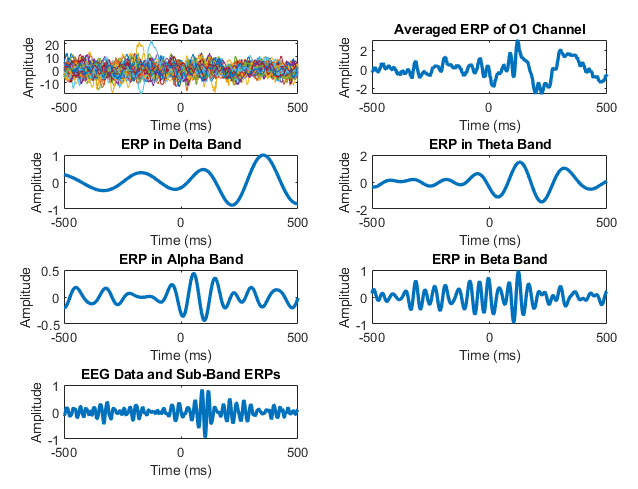
After obtaining sub-band ERPs, we can reveal the additional relationship between these sub-band ERP components. Cross-correlation analysis is a beneficial technique for quantifying the temporal correlation between two series.
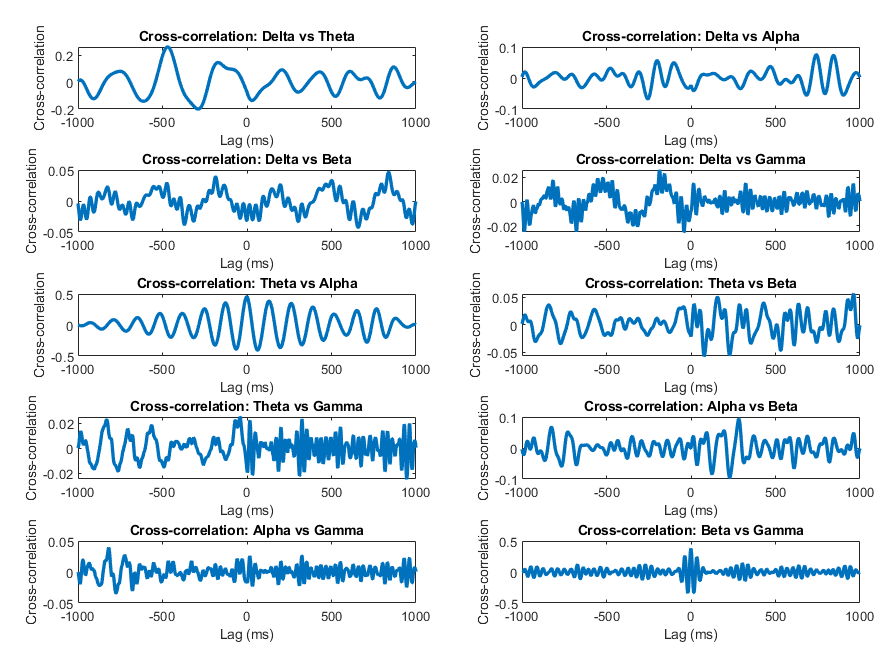
The time lag at the maximum correlation indicates the tendency of the sub-band ERPs for preceding or following dynamics concerning each other. We can clearly see that theta-alpha and beta-gamma ERPs have a biggest correlation at the zero lag.

You can find all codes in the following page;
https://github.com/Fatihcell/EEG-Analysis
 Neuroscience Diaries
Leave a comment